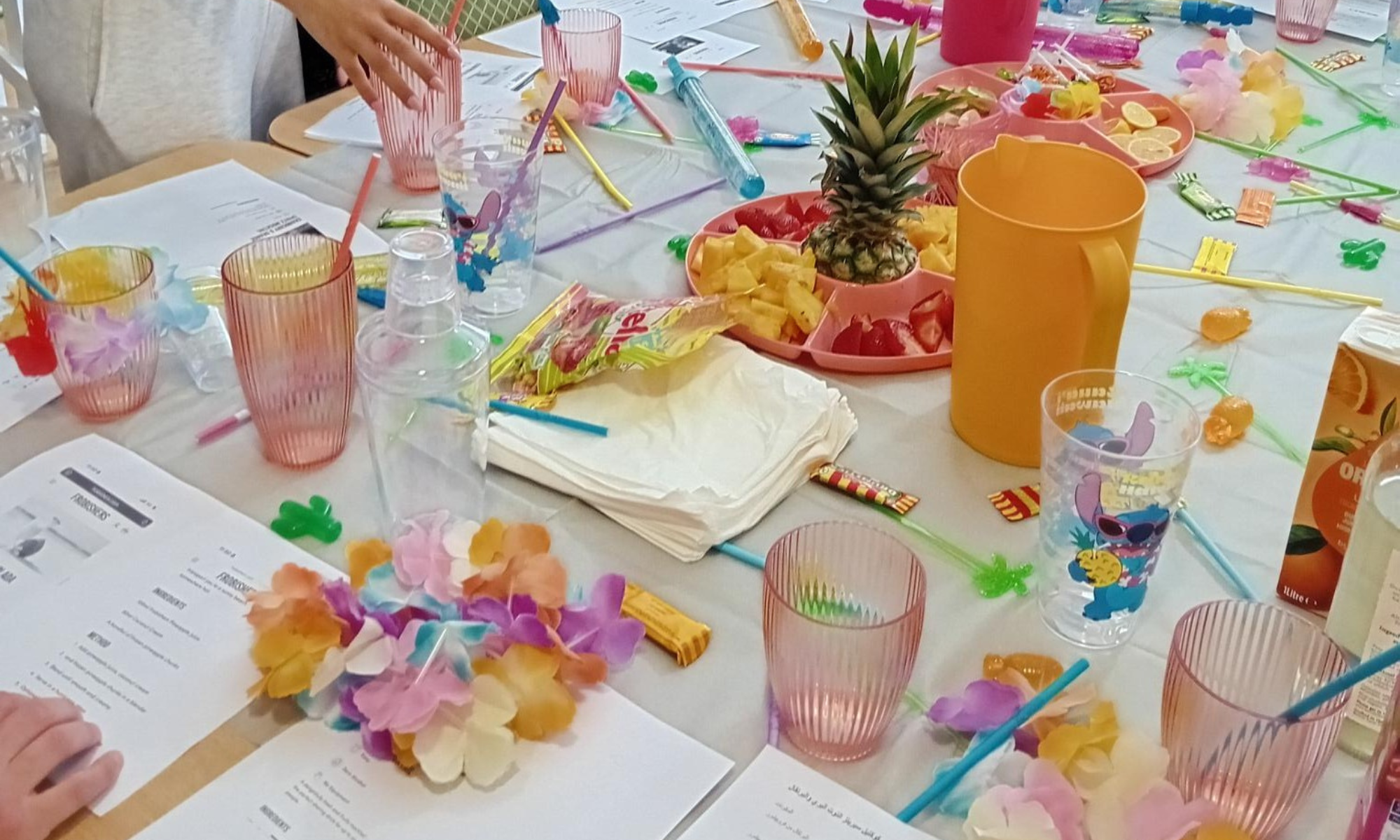
A burst of colour and creativity at one of our mocktail sessions. From fruity garnishes and tropical straws to recipe sheets and floral leis, every detail is designed to make sobriety feel celebratory. Victims and survivors gathered around the table to blend, shake, and share in a safe, alcohol-free space, proving joy doesn’t need gin.
Alcohol’s role in domestic abuse
Let us be very clear from the onset: Alcohol never causes domestic abuse. People do.
Yet time and again, victims and survivors tell us the words hurled at them after a violent episode are not “I’m sorry.” but “I was drunk.” In the UK, nearly 1 in 3 incidents of intimate partner violence involve alcohol consumption by the perpetrator (Office for National Statistics, 2024). While alcohol does not create abusive beliefs, it can lower inhibitions, magnify anger, and most dangerously, provide a readymade excuse.
Rosie’s story: Fighting for her child and her sobriety
For Rosie, alcohol was central to the violence she endured.
“I was carrying my two-month-old baby in my arms when I was attacked by my husband in the presence of my mother-in-law. They were both intoxicated and it wasn’t the first time.” – Rosie*
Perpetrators often rely on three myths:
- Loss of control – “I can’t remember what I did, so I’m not responsible.”
- Mutual blame – “We both drank; the argument just got heated.”
- One-off incident – “It was the drink talking, not me.”
These narratives deflect accountability and pressure victims and survivors into forgiving the unforgivable.
In many relationships, the bottle itself becomes an instrument of abuse:
- Coerced drinking – topping up a partner’s glass to impair their judgement or silence resistance.
- Financial abuse – spending household money on alcohol, then blaming the victim for “nagging” about debt.
- Monitoring sobriety – sabotaging recovery programmes or mocking abstinence efforts.
The result is what researchers call “dual harm”: the violence of the perpetrator compounded by the toxic effects of alcohol misuse.
For victims and survivors, the same substance used to excuse harm can feel like the only anaesthetic for trauma. Up to 40 % of women in refuge services report using alcohol and other substances to manage flashbacks, insomnia, or panic attacks (Women’s Aid, 2023). Self-medication provides temporary relief but risks dependence, health issues, and additional shame when society labels survivors “problem drinkers.”
“After I left, my husband refused to give me access to my baby despite my numerous attempts to get her back. He said I was a drug addict and cannot be trusted with a child. I had used substances recreationally in the past. We had done together, but I wasn’t an addict. At least I didn’t think so. But I knew he was going to use this against me. I believe he was trying to send me into a downward spiral of substance abuse, by refusing me access to my child. I was worried that I would fall into bad habits and start bingeing to cope.” – Rosie*
The vicious cycle
- Abuse escalates at home.
- Alcohol use increases as either excuse (perpetrator) or escape (victims or survivor).
- Physical, emotional, and financial harm multiply.
- Stigma keeps victims and survivors isolated: “I can’t ask for help; they’ll think I’m a drunk or that I deserve it.”
Breaking a cycle this tangled requires more than a detox programme or a safety plan in isolation. It demands an integrated, trauma informed response.
Our approach: Healing the whole person
Thanks to funding from the Henry Smith Foundation, our support combines domestic abuse advocacy with specialist substance misuse support:
- 121 sessions with our Recovery Caseworker – exploring triggers, setting sober goals, and accessing clinical referrals.
- Naloxone training – in partnership with Recovery Near You, we have trained frontline staff to administer Naloxone, a life-saving medication that can reverse opioid overdoses.
- Random drug-testing – can be offered to women using the service in requested, to document and support their recovery, particularly useful in cases involving social care or custody proceedings.
- Gym membership – was provided to some women in the past and those who were part of this cohort told us that channelling their energy into physical activity significantly supported their recovery journey.
- Peer groups like the Mix & Mingle Mocktail Masterclass, where sobriety is normalised and joyful.
At The Haven, women are met with compassion, practical tools, and belief in their potential.
“I was assessed by a Recovery Caseworker at The Haven Wolverhampton and a plan was put in place to keep me on the right track. We agreed that I would take random drug tests which would not only keep me motivated but also provide evidence to prove my innocence in court.” – Rosie*
Rosie* was facing a custody battle while trying to recover from the trauma of abuse and substance misuse. The Haven Wolverhampton funded and arranged a programme of random testing for cocaine, cannabis, and opiates. Each time, she produced a clean result.
“At my custody hearing, my solicitor was able to present a spreadsheet with my drug test results, as well as a supporting letter from my case worker. I was very nervous, but my case worker had been very supportive, and she helped me to stay positive and hopeful.”
The outcome changed her life.
“Then the news came; I was getting my baby back! I have The Haven Wolverhampton to thank for this victory. I don’t think the judge would have ruled in my favour without evidence that I had been drug-free.”
Even after the hearing, Rosie* chose to continue the random tests to support future court proceedings and her own recovery.
“I have decided to continue taking random drug tests to keep me on track and to support any further court cases or support plans.”
*Name changed for confidentiality.
What needs to change:
- Policy: Mandatory perpetrator programmes must address substance-fuelled excuses head-on.
- Healthcare: A&E staff as a rule should screen for domestic abuse when treating alcohol related injuries.
- Workplaces: Ditch the default option of going out for a pint and offer alcohol-free socials so victims and survivors aren’t forced to choose between being part of their workplace culture and their sobriety or safety.
- Community: Challenge the idea that alcohol is a prerequisite for fun. When drinking is the default way to socialise, it isolates those in recovery. Someone you know may be going through this. Swap judgment for genuine curiosity and ask, “How can I support your sobriety?”
Help is available
- The Haven Wolverhampton Helpline (24/7): 08000 194 400
- Wolverhampton Substance Misuse Service: 0300 200 2400
- SUIT Recovery Wolverhampton: 01902 328 983
- National Domestic Abuse Helpline (24/7): 0808 2000 247
- Drinkline (9 a.m.–8 p.m.): 0300 123 1110 (More on Drinkaware’s support options here)
If you recognise your own story here, remember: alcohol may blur the memories, but it never blurs your right to live free from harm.
Please get in touch and we would be happy to help.
To find out more about how you can support our work, visit our donation page here.